
Philosophy
The key feature of Experience Based Learning (EBL) is that the learner is central to all teaching and learning (Andresen, Boud, & Cohen, 2000). This experience can come from prior learning, lived experiences, or from participation in activities implemented by teachers and facilitators. The most well known theory of EBL is that of Kolb’s cycle of four elements (D. Kolb, 1983; D. A. Kolb, 2014)
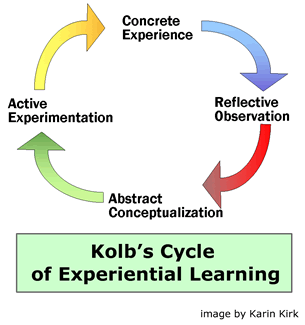
The cycle starts with the child having an experience, followed by the child reflecting either on their own or with others about that experience. This is then followed by a period in which they begin to conceptualize the experience and draw conclusions, often starting to apply the concept they have learnt to other experiences they might have had (Carleton University, 2004). Leading to changes in behaviour through experimentation as they try out various behaviours and watch for responses (Oxendine et al., 2004).
Pedagogy
The pedagogy ofEBL has been discussed by Boud, Cohen and Walker (1993) and Ballantyne and Packer (2009). Both these sets of authors agree that there are certain beliefs or assumptions that define the way that EBL is practiced by teachers. While Boud et al. (1993) have a focus on experience being the foundation of learning and in fact providing the stimulus for the learning, Ballantyne and Packer (2009) would describe this process as simply the provision of real life learning experiences. Ballantyne and Parker (2009) also describe their learners as learning by doing, whereas Boud et al. (1993) would reword this as learners being able to actively construct their own learning experiences. Both authors agree that learning is a holistic process with Ballantyne and Parker (2009) adding that they feel that there needs to be engagement of the whole senses. Both authors also agree on the concept that learning is socially and culturally constructed and that due to this fact, concepts will be understood in different ways depending on these cultural and social bounds. Finally, while Boud et al. (1993) suggest that learning is influenced by the persons socio-economic context and the context in which it occurs. Ballantyne and Packer (2009) simply believe that the process of being in a particular environment will impact on the learning occurring there regardless of socio-economic factors.
Setting
EBL has many forms that is used across the vocational, educational and professional arenas. These include internships, work-placements and on the job training, all of which allow students and young adults to gain experience in an area of work they are interested in (Andresen et al., 2000). Excursions, adventure and wilderness trips, which are used to educate in a variety of areas including the very famous or infamous depending on your outlook Sir Edmund Hilary Outdoor Pursuit Centre which has educated generations of youth on safely navigating the wilderness we have in New Zealand and allows many a taste of an experience they wouldn’t otherwise even think of, including camping, kayaking and sleeping in ice caves in the middle of winter (Andresen et al., 2000). Medical students and trainee teachers will be very familiar with the use of laboratories, workshops, clinicals, and practicums. Along with Case studies, role plays and hypotheticals. There are also more subtle methods including simulations, models, groups discussions, written reflections, and self-directed projects (Andresen et al., 2000).
Role of the Girls

The entire point of EBL is that the child leads the learning, choosing what they wish to learn and how (Andresen et al., 2000). This is a concept that strongly underpins the guiding movement with girls as young as five being encouraged to make their own choices and lead their learning (Girl Guiding New Zealand, 2011, 2018). At all levels the girls are responsible for planning their own programmes both individually and as a group around interests and needs (Girl Guiding New Zealand, 2011). The leaders encourage the girls to test boundaries and try new skills, taking part in a range of activities that include the outdoors, conservation, caring for others and keeping themselves safe in cyber space. The girls are also encouraged to include others in their activities and to work as role models for the younger girls.
Role of the Parents
Parents can be involved in a range of roles; however, the roles are helping roles. Helping at meetings, helping provide transport, spending time watching the girls at various activities such as camping, hiking and badge examinations.
References
Andresen, L., Boud, D., & Cohen, R. (2000). Experience-based learning. Understanding adult education and training, 2, 225-239.
Ballantyne, R., & Packer, J. (2009). Introducing a fifth pedagogy: Experience‐based strategies for facilitating learning in natural environments. Environmental Education Research, 15(2), 243-262.
Carleton University. (2004). What is experience based learning Retrieved from https://serc.carleton.edu/introgeo/enviroprojects/what.html
Girl Guiding New Zealand. (2011). A Guide to Guiding. Retrieved from https://girlguidingnz.org.nz/wp-content/uploads/2018/09/A-Guide-to-Guiding.pdf
Girl Guiding New Zealand. (2018). Girl-Led Programmes. Retrieved from https://girlguidingnz.org.nz/programmes/girl-led/
Kolb, D. (1983). Experiental Learning: Experience as the source of Learning and Development.
Kolb, D. A. (2014). Experiential learning: Experience as the source of learning and development: FT press.
Oxendine, C., Robinson, J. & Wilson, G. (2004). Experiential learning. In M. Orey (Ed.), Emerging Perspectives on Learning, Teaching & Technology. Retrieved August 4, 2019, from http://projects.coe.uga.edu/epltt/.

